

Election Day 2022: Why security experts predict a chaotic mess
Election Twenty-four hour period 2020: Why security experts predict a chaotic mess
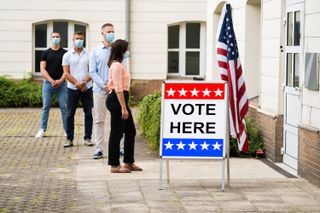
This autumn's U.S. presidential election may terminate up being a chaotic mess that won't yield a winner on Election Dark, three election-security experts told the Black Hat 2020 security conference during its opening day Wednesday (Aug. 5).
U.s.a. don't know how many absentee ballots they need to send to voters, how early to tell voters to postal service the ballots back or how they're going to count those ballots in a timely manner, one adept warned.
- Trump attacks post-in voting fraud — just election officials say it's prophylactic
- Worried almost Election Twenty-four hours hacking? Here's what you need to know
- The best antivirus software to keep your PC make clean
Some voters who try to cast their ballots in person will find their regular polling places airtight, and long lines may form at those that are open as a smaller-than-usual number of election workers endeavour to limit crowds.
"On November third, it'south quite possible that we won't know who won the election."
Christopher Krebs, CISA
Meanwhile, the Russians will go along to inundation American social media with disinformation, and the Chinese and Iranians may join in. Russian tactical hackers could fifty-fifty effort to disrupt the actual voting with strategic power outages or destructive malware on electoral figurer systems, as they've already done in other countries.
"On Nov third, it'south quite possible that nosotros won't know who won the ballot," said Christopher Krebs, director of the Department of Homeland Security'south Cybersecurity and Infrastructure Security Agency (CISA). "So nosotros you need you to be a more than patient voter and recognize that information technology's going to take a little more than time."
'A Sputnik moment'
In his Blackness Hat presentation, taped the night before it was streamed out to attendees of this year's virtual conference, Krebs tried to project a positive notation.
"Iv years agone at this time, it was becoming very articulate that Russia was intent on disrupting the election," he said. "But if you talk to anyone in the terminal administration, they would not have been happy with the response," which was quickly pulled together from diverse agencies for a scenario that had not been planned for.
"It was almost a Sputnik moment," Krebs said, comparing information technology to the mean solar day in Oct 1957 when the U.S. realized that its military forces could not protect its skies from Soviet satellites. "Before this, cybersecurity incidents were financial crimes or a bad movie. Suddenly it was very real."
"But we got to run into the Russians' playbook," Krebs added, enabling the U.South. national-security establishment to program for the next presidential election.
"Today in 2020," he said, we're much better prepared for the Russian disinformation and hacking threat. "It'south night and twenty-four hour period."
Krebs cited much amend visibility into the varied American ballot systems, greater understandings of the risks involved, and progress in making certain that all voting precincts record the votes on some kind of paper trail -- 92% would exist compliant by Election Solar day 2020, Krebs said, as opposed to simply fourscore% in 2016.
"We accept the conviction that 2020 will exist the nearly secured, most protected ballot in modern history," he predicted.
'Can we postpone a national ballot?'
Matt Blaze, a calculator-science professor who holds the McDevitt Chair in Reckoner Science and Law at Georgetown University, wasn't and then optimistic.
Delivering Wednesday's Blackness Hat keynote address, Blaze lamented that the slow but steady progress made in election security over the by decade had been disrupted by the COVID-xix crisis.
Is absentee voting scalable in an emergency? This is a systems and logistics problem.
Matt Blaze, Georgetown University
"I've never encountered a problem that'due south more complex than the security of civil elections," Blaze said, notwithstanding he was glad to see earlier this year, for example, that touchscreen voting machines that don't impress a paper readout were slowly being phased out.
"So this all sounded good in February," he added. "Then March and the coronavirus pandemic came along."
Our election systems are just not prepared to handle the resulting huge expected influx of mail-in ballots, Blaze said, with the exceptions of counties or states like Oregon where mail-in ballots are the norm.
- Mail-in voting: How to vote by mail service, fraud concerns, state deadlines and more than
"Absentee voting is permitted past every country, but the scale varies," he said, pointing out that some states require to voter to provide a reason why he or she can't vote in person, although more states let y'all exercise it for whatever reason. "But is absentee voting scalable in an emergency? This is a systems and logistics trouble."
The U.S. has dealt with regional or national voting disruptions before, such as caused by natural disasters, the Ceremonious War or even the 9/eleven terrorist attacks (a mayoral primary day in New York Urban center).
Only, Blaze said, we've never seen annihilation like this before, when millions of people will want to vote just won't want to become to polling places. Many of those polling places, such equally in schools or authorities buildings, will be closed anyway.
As Krebs put it later in the 24-hour interval during his own presentation, on Election Day, "something will have inverse in way you lot vote. Your polling place might not exist bachelor."
"At that place'southward lots of dubiousness about how many voters volition need mail-in ballots," Bonfire said. "We probably won't know until it'southward too late to modify course. Nosotros'll demand to ready for a very wide range of scenarios."
Amidst those scenarios, Blaze admitted, might exist one that would extremely disruptive and would crave congressional approval.
"Tin can nosotros postpone a national election?" Blaze asked rhetorically. "Nosotros never accept before. The Speaker of the Business firm could become acting president" — which would happen if a president's term ran out without an elected successor — "but that might be preferable to accepting an election viewed as illegitimate."
Information confrontation
Making certain U.S. elections are bandage in doubtfulness is one of the Kremlin's chief goals, Booz Allen Hamilton threat-intelligence analyst Nate Embankment-Westmoreland said in the day's tertiary ballot-security address.
Beach-Westmoreland said the Russians accept tried to influence U.S. elections since at least 1976, when the KGB tried to derail the presidential entrada of defense hawk Sen. Henry "Scoop" Jackson by forging false FBI files alleging that Jackson was gay and sending them to major newspapers.
None of the newspapers ran the stories, Embankment-Westmoreland said, and Jackson's entrada fizzled out on its own. But afterward Vladimir Putin took charge in Russia on the last twenty-four hour period of 1999, efforts at what Beach-Westmoreland chosen "information confrontation" began anew.
"Russian federation has been incorporating data confrontation into its war machine strategy since 2000," Beach-Westmoreland said.
Bad actors may endeavour to disrupt the U.Southward. presidential election by using destructive wiper malware to hack election systems or by creating localized power outages to disable electronic voting machines.
Disinformation vs. destruction
In that location are ii sides to this, he said. The "information psychological" side is what hitting us in 2016, with the break-in at the Democratic National Commission, the media leaks of mixed faux and real data, and the social-media campaigns aimed at stirring up trouble.
These campaigns have been carried out by a group information-security specialists call Fancy Comport, Sofacy or APT 28, and it's function of the GRU, the Russian military-intelligence agency. Fancy Bear has used similar tactics in France, Republic of bulgaria, Ukraine and Montenegro.
Even though Russia'southward favored candidates take rarely won, Embankment-Westmoreland said, these disinformation campaigns nonetheless further Russia's goals.
"At that place's a greater utility to this than just changing outcomes," he said. "You lot can undermine your opponents, create new opportunities, and shape domestic opinions in Russia itself" by showing that Western democracy is flawed.
Withal there'due south a worse side to GRU hacking, said Beach-Westmoreland. The "information technical" group, aka Sandworm or Blackness Energy, has hit many countries with destructive cyberattacks.
This group is blamed for disabling Ukrainian ability plants in 2016, launching the NotPetya worm that destroyed computers across Europe in 2017 and taking down the computer systems at the Pyeongchang Winter Olympics in 2018.
Yet Sandworm/Black Energy has never been very active in the United states. The GRU did probe the election systems in all 50 states in 2016, as Krebs noted during his presentation earlier Wednesday, simply that may only have been reconnaissance.
Beach-Westmoreland says information technology's possible, if unlikely, that the Sandworm/Blackness Free energy grouping might try to disrupt the U.Due south. presidential election past using subversive wiper malware to hack election systems or by creating localized ability outages to disable electronic voting machines.
Such attacks would create a massive blowback from the U.S. government, which has stated that they would constitute an act of state of war. Russian federation has generally used these tactics only on countries it doesn't have to fear militarily.
Deterrence is "a matter of shaping your adversary's take a chance calculus," Embankment-Westmoreland said. "Draw clear bright lines for which there will be consequences if they're crossed."
Along those lines, the U.Due south. State Department on Wed appear rewards of up to $10 million, and a website, for tips leading to the identification of anyone seeking to disrupt U.S. elections.
Patience, please
Deterrence conspicuously has not worked to end the Russians from spreading disinformation, which Krebs said is every bit much of a threat as it's e'er been.
"On the intelligence side, election-infrastructure targeting is non like what nosotros've seen in 2016," he said while taking questions afterwards his ain presentation. "Merely in the disinformation space, Russian federation has never taken its pes off the gas. China and Iran are as well in the game."
To American voters and social-media users, Krebs urged them to non fall victim to false-news campaigns designed to spark outrage and viral sharing.
"Consider your sources of information," he said. "Think earlier y'all share. In that location are [news] outlets out there similar Sputnik or RT [Russia Today] that are closely associated with the Kremlin."
"We could be attacked past a very capable adversary," Krebs said about the next three months. "We have to factor COVID-xix in. And we require the voter to accept patience."

Source: https://www.tomsguide.com/news/election-mess-scenarios-bh2020
Posted by: gonzalezoneins.blogspot.com
0 Response to "Election Day 2022: Why security experts predict a chaotic mess"
Post a Comment